
SyloSpace

The future of work: AI, shorter weeks and healthier desks

AI is already common at work, but its productivity effects vary widely, while shorter weeks and daily movement show clearer benefits.

Updated 4 days ago1 min readVersion 3
CommentsFollow

Covers: Knowledge and office work. Each major change has its own Sylo as a subtopic; this page ties the evidence together.

3 free full reads left this month. Join or upgrade
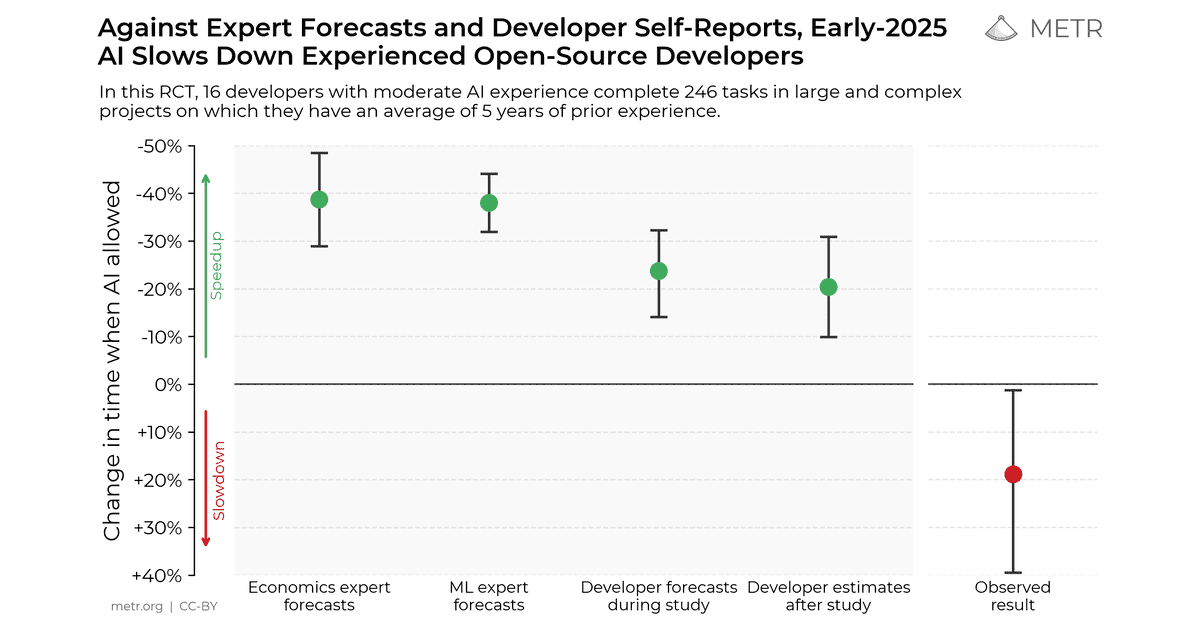
Image: METR

The short answer

Interpretation

Knowledge work is changing fast, but claims are running ahead of evidence. AI tools are already used by most knowledge workers, yet measured productivity effects range from strong gains to slowdowns depending on the task and the person. Four-day week trials show wellbeing gains among volunteer firms, and desk-based health depends more on moving than on standing.12345

What this rests on5 independent sources · 3 versions
  • Evidence 8
  • Interpretation 1

In brief

  1. Three in four knowledge workers already use generative AI at work, often with tools they bring themselves.1

    Evidence-backed
  2. AI's measured effect on productivity varies by task and experience, from 26% more output to 19% slower.23

    Evidence-backed
  3. Shorter-week trials show consistent wellbeing gains among participating firms.4

    Evidence-backed

At a glance

The picture in numbers

Live · updated just now

Survey of 31,000 people by Microsoft and LinkedIn, 2024

75%

75 in every 100

of knowledge workers use generative AI at work1
Survey of 31,000 people by Microsoft and LinkedIn, 2024

78%

78 in every 100

of those AI users bring their own tools1
Field experiments and a study of experienced developers
  • more completed tasks26%
  • slower19%
AI's effect on productivity in software work23
Trials linked to lower burnout and better health

141 organisations

141 organisations: organisations in four-day week trials45

The evidence behind it

8 sources
  • Reviews of many studies1
  • Other studies and data5
  • Background2

When it was published

Newest from 2026

20162026
Sources on this page by kind and year
SourceKindYear
AI at work is here. Now comes the hard part (2024 Work Trend Index)Background2024
The effects of generative AI on high skilled work: evidence from three field experiments with software developersOther studies and data2024
Work time reduction via a 4-day workweek finds improvements in workers' well-beingOther studies and data2025
Does physical activity attenuate, or even eliminate, the detrimental association of sitting time with mortality?Other studies and data2016
Measuring the impact of early-2025 AI on experienced open-source developer productivityBackground2025
Science Is About Thinking: How Can We Protect Thinking Time in a Distracted Digital World?Other studies and data2026
Artificial Intelligence and Occupational Health: Global Umbrella Review of Applications and Limitations.Reviews of many studies2026
From automation to symbiosis in Industry 5.0 manufacturing: the human-centered AI adoption maturity cube.Other studies and data2026

The community around it

Contributions
0
People
0
Following
0

Nobody has added anything yet. Experience, evidence or a different view would show up here.

What it means for you

Which fits you?

Pick the situation closest to yours. Each answer says what it rests on.

If you're deciding how your team should adopt AI

Pilot it with measured outcomes rather than surveys; people consistently overestimate AI's speed-up. See the AI coding Sylo for detail.3

Evidence-backed

If you're worried about burnout on your team

The four-day week has the best evidence of any structural change reviewed here for reducing burnout, at least among volunteer firms.4

Evidence-backed

The full story · 3 chapters

01

AI is already everywhere

AI summary:Most knowledge workers already use generative AI, and many bring their own tools instead of waiting for employers.

Evidence-backed

Evidence-backed: Microsoft and LinkedIn's 2024 survey of 31,000 people found 75% of knowledge workers use generative AI at work, and 78% of those users bring their own tools rather than waiting for employers.1

02

But its productivity effect is contested

AI summary:Studies disagree: some find large gains in completed tasks, while one found experienced developers slowed down.

Evidence-backed

Evidence-backed: In software, where it's been studied most, large field experiments found 26% more completed tasks, while a careful study of experienced developers in their own codebases found a 19% slowdown.23

03

Time and health

AI summary:Four-day week trials were linked to less burnout and better health, and daily activity matters more than standing.

Evidence-backed

Evidence-backed: Four-day week trials across 141 organisations were associated with lower burnout and better mental and physical health. At the desk itself, an hour or so of daily moderate activity matters more for long-term health than standing.45

Reporting up to this Sylo

From its subtopics

Each subtopic is its own Sylo with its own sources and contributors. Their current findings are shown here as reports, not counted as extra evidence for this page.

DebateDo AI coding assistants make developers faster?It depends on who and what. Controlled experiments and large company field trials found real speed-ups, from 26% more completed tasks to 56% faster on a single task, mostly for less experienced developers. But a rigorou…Changed 4 days ago · Removed a survey poll that wasn't a close enough match to this topic.Open ›UnderstandDo open plan offices reduce collaboration?The evidence remains mixed and does not settle the question. One small prospective field study found that a move to a more open office increased observed face-to-face interaction, while a reference overview states open-…Changed 15 hours ago · Added three newer qualitative and preference studies (activity-based flexible offices, activity-based workplaces in a municipality, and a discrete choice experiment on workspace preferences) that broaden the picture beyond the two original studies: they consistently report increased interaction alongside persistent privacy, noise, and confidentiality problems, and show that preferences depend on personal and work circumstances.Open ›UnderstandDo short breaks improve focus and reduce fatigue at work?Short breaks can reduce fatigue and help people feel more energetic. Evidence for better overall task performance is less convincing, so a break should not be presented as a guaranteed productivity boost.Changed 4 days ago · Editorial review: added foundational research, distinguished direct evidence from related findings, and clarified practical limits.Open ›UnderstandDo smartphone notifications disrupt concentration even when ignored?The evidence is mixed. One controlled experiment found that simply receiving phone notifications, even without checking them, significantly disrupted attention and task performance. A separate 240-participant virtual-cl…Changed 8 hours ago · Broadened beyond the single 2015 experiment: added a 240-participant virtual-classroom experiment showing pop-up notifications impaired attention and retention, a medical-education study showing distraction blocked instructional benefits, and null results from two other experiments. Added guidance on digital experience and on distraction-rich learning, plus new open questions.Open ›UnderstandDoes a long commute harm wellbeing?The evidence available so far does not directly answer whether a long commute harms wellbeing. The clearest quantitative signal comes from a Canadian post-secondary survey, where longer commute time was strongly associa…Changed 4 hours ago · AI-prepared Starting Map from live research.Open ›UnderstandDoes better office ventilation improve concentration?A controlled office study found better cognitive-test scores under improved indoor-air conditions, including higher ventilation. That supports taking office air quality seriously, but it does not establish how much open…Changed 4 days ago · Editorial review: added foundational research, distinguished direct evidence from related findings, and clarified practical limits.Open ›UnderstandDoes multitasking make people less productive?The evidence points mostly one way: dividing attention across tasks tends to cost performance. Multitasking wastes time through context switching and raises error rates from insufficient attention, and people who multit…Changed 4 hours ago · AI-prepared Starting Map from live research.Open ›UnderstandDoes music help you concentrate?Whether music helps or hinders concentration depends on the task, the music, and the listener. In a laboratory experiment, music generally impaired complex task performance, while complex music facilitated simple task p…Changed 15 hours ago · Added two recent meta-analyses: one on music listening habits and cognitive performance (small benefits for global cognition, memory and executive function, weaker and more heterogeneous attention effects, stronger in older and clinical populations) and one on music-based interventions for test anxiety (large reduction in test anxiety across 10 RCTs).Open ›DebateDoes raising the minimum wage cost jobs?The evidence does not point one way. A study of Seattle's 2015–2016 minimum wage increases, using Washington State administrative data, found no change in the probability that individual low-wage workers stayed employed…Changed 4 days ago · Initial Starting Map for the question of whether minimum wage increases cost low-wage workers jobs or hours. Built from two peer-reviewed studies that reach different conclusions: a Seattle-focused study finding hours reductions without job loss, and a national wage-bin study finding little net change in low-wage jobs. No reader contributions yet, so the map rests on two sources with different designs and geographies.Open ›UnderstandDoes unconscious bias training change behaviour?The evidence here does not settle whether unconscious bias training (UBT) changes behaviour. One large study of 470 health-professions students found no systematic bias in stated helping intentions, expected patient adh…Changed 4 hours ago · AI-prepared Starting Map from live research.Open ›UnderstandHow does AI affect jobs and wages?Research on AI and work points in several directions at once. A startup-based measure of AI exposure finds that white-collar, high-skilled occupations are theoretically highly exposed but unevenly targeted: routine orga…Changed 8 hours ago · Added newer evidence on LLM exposure and job precarity, robot adoption and worker health, invulnerability bias in risk perception, and ageing immigrants' livelihood security. Expanded uncertainty and open questions to reflect that no source measures aggregate employment or wage effects directly.Open ›UnderstandHow does the Bank of England assess risks from the AI investment boom?No Bank of England Financial Stability Report, Financial Policy Committee statement or speech is present among the available sources, so the Bank's own published assessment of AI-investment risks cannot be quoted direct…Changed 20 hours ago · AI-prepared Starting Map from live research.Open ›SolveHow to stop procrastinating: what research says worksProcrastination is best understood as a failure of self-regulation rather than laziness: a meta-analysis of 691 correlations found the strongest and most consistent predictors were task aversiveness, task delay, self-ef…Changed 15 hours ago · Added newer experimental and longitudinal evidence: two single-session CBT/ACT interventions reduced procrastination in students, a 12-week online self-help trial reduced procrastination and stress in adults, and mediation analyses point to task value, task-related affect and self-regulation as mechanisms. Added a meta-analytic link between chronic procrastination and poorer self-rated health, partly explained by stress. Updated uncertainty, open questions, takeaways and guidance accordingly;Open ›DecideIs a standing desk worth it for your health?A standing desk will cut your sitting time, by roughly one to two hours a day in trials, but standing itself isn't exercise and doesn't appear to lower heart disease risk. The bigger health lever is moving: about an hou…Changed 4 days ago · Removed a survey poll that wasn't a close enough match to this topic.Open ›DebateIs working from home less productive?The evidence does not support a single answer. In a nine-month randomised experiment with call-centre employees at Ctrip, working from home raised performance by 13% — 9% from more minutes worked per shift and 4% from m…Changed 15 hours ago · Added two sources that were not reflected in the brief: a survey-based study of 646 remote workers finding no significant negative productivity impact, and background on remote work's history and claimed benefits. Added a section on the survey evidence, a poll on work setup, and updated uncertainty, open questions, takeaways and guidance to reflect the wider evidence base.Open ›DebateThe four-day work week: what the trials showIn trials so far, companies that moved to a four-day week at full pay mostly kept output steady and saw clear wellbeing gains, and most chose to continue. But participants volunteered, many measures were self-reported,…Changed 4 days ago · Added Iceland's public-sector trials and the 2025 peer-reviewed multi-country study, with the self-selection caveat.Open ›UnderstandWhat happens when people get a guaranteed income?Across four randomised trials in high-income countries, unconditional cash payments produced little or no reduction in employment: the US guaranteed-income trial found recipients worked about 1–2 fewer hours per week (w…Changed 15 hours ago · Added three newer randomised trials (Germany 2021–2024, a one-time $1,000 US transfer in 2020, and a 2018 NBER review) alongside the US guaranteed-income and Finnish experiments; the picture is now four randomised trials plus a review, all pointing to small or no employment effects, with wellbeing gains that are short-lived in the US study and not yet measured over the long run elsewhere.Open ›

Ask this Sylo

Still wondering about something?

Answers come only from this page's reviewed material, with citations, and say plainly when the page doesn't cover it yet.

Behind this page

Who's adding to it, where it comes from, how it changed and what would make it better. Always open to everyone.

Discussion

Nobody has added anything yet. If you have experience, evidence or a different view, you could be the first.

Sources

Numbers match the citations in the article. A working link isn't proof that a page supports a claim; check the quoted passage and date.

  1. 1
    AI at work is here. Now comes the hard part (2024 Work Trend Index)
    Microsoft and LinkedInPublished May 8, 2024Checked Sep 30, 2026
    “75% of knowledge workers use generative AI at work, and 78% of AI users are bringing their own AI tools to work.”
  2. 2
    The effects of generative AI on high skilled work: evidence from three field experiments with software developers
    SSRN working paper (Cui et al.)Published Sep 5, 2024Checked Sep 30, 2026
    “AI coding assistant access increased completed tasks by 26.08% across 4,867 developers.”
  3. 3
    Measuring the impact of early-2025 AI on experienced open-source developer productivity
    METRPublished Jul 10, 2025Checked Sep 30, 2026
    “Experienced developers took 19% longer with AI tools allowed.”
  4. 4
    Work time reduction via a 4-day workweek finds improvements in workers' well-being
    Nature Human Behaviour (Fan et al.)Published Jul 21, 2025Checked Sep 30, 2026
    “Four-day week trials across 141 organisations were associated with lower burnout and better wellbeing.”
  5. 5
    Does physical activity attenuate, or even eliminate, the detrimental association of sitting time with mortality?
    The Lancet (Ekelund et al.)Published Sep 24, 2016Checked Sep 30, 2026
    “60–75 minutes a day of moderate activity seemed to eliminate the extra mortality risk associated with high sitting time.”
  6. 6
    From automation to symbiosis in Industry 5.0 manufacturing: the human-centered AI adoption maturity cube.
    Frontiers in artificial intelligence (Liu)Published Aug 21, 2026Checked Oct 4, 2026
    “Drawing on literature on digital transformation, Industry 5.0, human-centered AI, trustworthy AI, work design, empowerment, inclusivity, and maturity models, the article argues that mature AI adoption depends on the alignment of three interdependent capabilities: AI and data capability, human work capability, and governance capability. The cube conceptually links these dimensions to four desired outcomes for future manufacturing jobs: augmentation, empowerment, inclusivity, and human-AI symbiosis. Rather than treating maturity as a linear sequence, the framework positions organizations according to different maturity configurations, such as fragmented pilots, technical acceleration, participatory but fragile adoption, governed but disconnected adoption, and symbiotic maturity. The article offers a modest scaffold for managers, engineers, worker representatives, and researchers seeking to align AI adoption with responsible and human-centered industrial renewal, while providing a conceptual basis for future assessment development and empirical validation.”
  7. 7
    Artificial Intelligence and Occupational Health: Global Umbrella Review of Applications and Limitations.
    Safety and health at work (Descatha et al.)Published Feb 24, 2026Checked Oct 4, 2026
    “Data extraction from these publications focused on applications of the technologies, strengths, and limitations of their utilization.ResultsFrom 1,884 initial hits, 33 reviews were included in this review, with only 4 systematic and 12 other systematized reviews. Many diverse AI applications in occupational health were found. Studies were identified from all continents and were mostly published in the last 15 years. The findings suggested that AI might have positive applications (risk prevention and monitoring, diagnosis, health, and well-being, training and skills development, automation and robotics, sector-specific applications, and organizational efficiency). Data and security, reliability, and limitations of AI systems, impacts on workers, governance and ethics, and scientific and methodological limitations were noted. However, the level of evidence is low and further specific studies will be needed, especially worker-centered studies with a health equity perspective.ConclusionThe application of AI to OHS requires proactive policy, worker participation, and evidence-informed risk management, with rigorous impact assessments and ongoing research.”
  8. 8
    Science Is About Thinking: How Can We Protect Thinking Time in a Distracted Digital World?
    Brain sciences (Dhahbi et al.)Published Jun 27, 2026Checked Oct 4, 2026
    “e cognitive effects of digital interruption in professional and/or research settings were included.Results and interpretationDeep thinking and protected thinking time are treated as distinct constructs: the former as a sustained, integrative cognitive process supported by coordinated executive control and default mode network activity, the latter as uninterrupted temporal intervals within which that process can occur. Repeated engagement with task-irrelevant digital stimuli is associated with cortico-striatal strengthening and prefrontal-parietal under-consolidation, producing a plasticity paradox in which attentional fragmentation becomes self-reinforcing. The emergence of generative artificial intelligence introduces a qualitatively distinct threat through voluntary cognitive offloading, which reduces deep engagement independently of attentional distraction.ConclusionsEvidence-based strategies spanning individual, team, organizational, technological, and assessment levels are available to preserve protected thinking time. Direct evidence linking these intervals to specific research-impact outcomes remains limited, and institutional interventions should be prospectively evaluated.”

How it changed

Published 3 times since Sep 30, 2026.

  1. Version 3Sep 30, 2026Live now

    Connected the four-day week and standing desk subtopics.

    • Added section “Time and health”.
    • Key takeaways were added.
    • 2 new pieces of guidance for specific situations.
  2. Version 2Sep 30, 2026

    First brief linking AI adoption at work with the evidence on productivity.

    • The main finding was rewritten.
    • Added section “AI is already everywhere”.
    • Added section “But its productivity effect is contested”.
  3. Version 1Sep 30, 2026

    Created the Sylo.

    • First published version.
Every version, side by side

Help improve it

The brief is open about what's uncertain. These are the specific gaps that new material would fill.

  • “AI is already everywhere” rests on one independent source

    A second, independent source that confirms or challenges it would make this part more reliable.

Open questions

  • Which topic should join this map next: remote versus office work, AI and hiring, or meeting overload?

    No answers yet

  • Could AI productivity gains fund shorter working weeks, and has any company tried it?

    No answers yet

Around this topic

Sylos connect: narrower topics report up to broader ones, so what's learned in one place shows up where it matters.

Add what you know

Sign in to add what you know. Reading stays open to everyone.

Ask this Sylo

Answers only from “The future of work: AI, shorter weeks and healthier desks”

Ask anything about this page. The AI reads only its reviewed brief, sources and contributions, cites what it used, and says when the page doesn't cover something.