

Do AI coding assistants make developers faster?
AI coding tools speed up some developers and slow down others, so teams should measure their own results instead of trusting how fast AI feels.
Covers: AI assistants used for writing, editing and reviewing code in professional and open-source work. Covers controlled experiments, field studies and developer surveys up to 2025.
3 free full reads left this month. Join or upgrade
The short answer
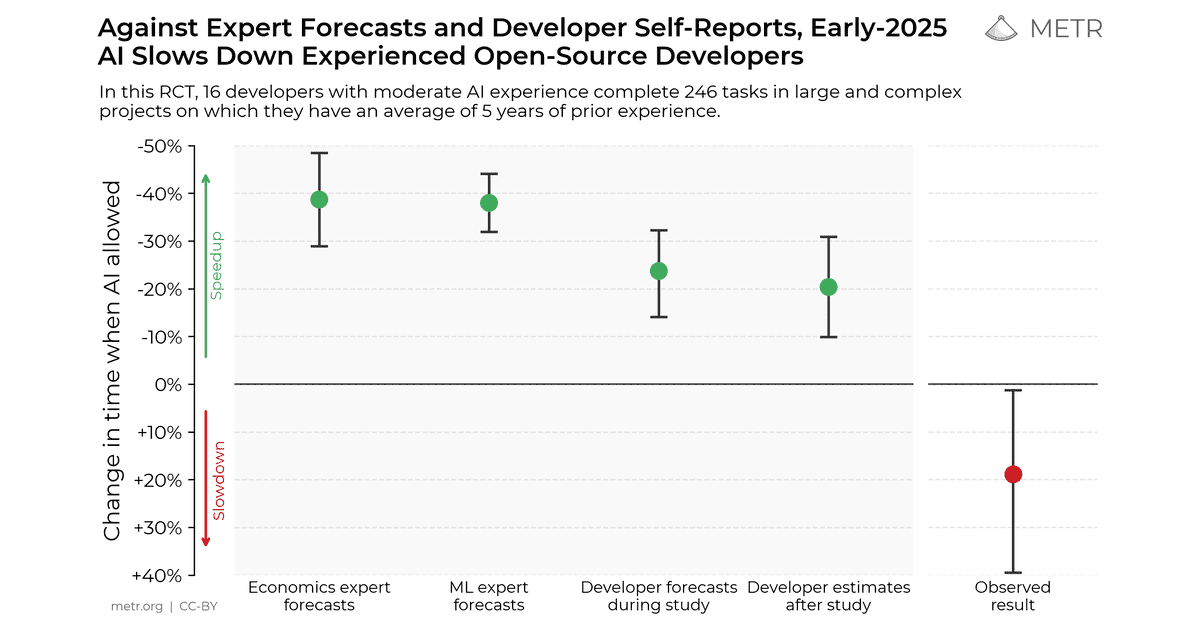
Evidence-backedIt depends on who and what. Controlled experiments and large company field trials found real speed-ups, from 26% more completed tasks to 56% faster on a single task, mostly for less experienced developers. But a rigorous 2025 study of experienced developers in their own mature codebases found AI made them 19% slower while they believed it made them faster. Self-reported productivity is not a reliable guide.123
- Evidence 15
- Interpretation 3
In brief
In a large field experiment, AI assistants raised completed tasks by 26%, with the biggest gains for less experienced developers.2
Evidence-backedExperienced developers working in their own large codebases were 19% slower with AI, yet believed they were 20% faster.3
Evidence-backed84% of developers use or plan to use AI tools, but more distrust their accuracy than trust it.4
Evidence-backedAt team level, more AI adoption was associated with slightly lower delivery throughput and stability.5
Evidence-backedMeasure your own team's outcomes rather than relying on how fast AI feels.3
Interpretation
At a glance
The picture in numbers
Live · updated just now
84%
84 in every 100
- Distrust46%
- Trust33%
The evidence behind it
6 sources- Other studies and data5
- Background1
When it was published
Newest from 2026
| Source | Kind | Year |
|---|---|---|
| The impact of AI on developer productivity: evidence from GitHub Copilot | Other studies and data | 2023 |
| The effects of generative AI on high skilled work: evidence from three field experiments with software developers | Other studies and data | 2024 |
| 2025 Stack Overflow Developer Survey: AI | Other studies and data | 2025 |
| Accelerate State of DevOps Report 2024 | Other studies and data | 2024 |
| Measuring the impact of early-2025 AI on experienced open-source developer productivity | Background | 2025 |
| Coding Alone? AI-Assisted Software Work and the Decoupling of Productivity from Public Knowledge-Infrastructure Participation. | Other studies and data | 2026 |
The community around it
- Contributions
- 0
- People
- 0
- Following
- 0
Nobody has added anything yet. Experience, evidence or a different view would show up here.
What it means for you
Which fits you?
Pick the situation closest to yours. Each answer says what it rests on.
If you're earlier in your career or working in an unfamiliar codebase
The evidence for gains is strongest here: field experiments found bigger improvements for less experienced developers.2
Evidence-backedIf you're an expert in a large, mature codebase
Be sceptical of the feeling of speed. In the METR study, experts were slower with AI; reviewing and fixing its output took time.3
Evidence-backedIf you lead an engineering team rolling out AI tools
Track delivery stability and change failure rates, not just output. DORA found team-level delivery metrics slipped as AI adoption rose.5
Evidence-backedIf you're writing a small, self-contained piece of code from scratch
This resembles the task where Copilot users were 56% faster; the speed-up is most plausible for well-specified greenfield work.1
Evidence-backedThe major studies compared
Best fit for your priorities: Three field experiments (2024)
- 1Three field experiments (2024)Good fit
- 2Copilot lab experiment (2023)Adequate fit
- 3METR open-source study (2025)Adequate fit
See every rating and what it rests on
| Criterion | Copilot lab experiment (2023) | Three field experiments (2024) | METR open-source study (2025) |
|---|---|---|---|
| Measured speed gain | Excellent155.8% faster on one task | Good226% more completed tasks on average | Poor319% slower with AI allowed |
| Rigour | Adequate1Randomised, but a single task with 95 recruited developers | Good2Randomised across 4,867 developers, though output measures are proxies | Good3Randomised per issue with screen recordings, but only 16 developers |
| Realism of tasks | Weak1A standardised greenfield task, not an existing codebase | Good2Developers' regular work at three companies | Excellent3Real issues in large, mature repositories the developers knew well |
- Copilot lab experiment (2023)I've used it0I'd recommend it0I had problems with it0
- Three field experiments (2024)I've used it0I'd recommend it0I had problems with it0
- METR open-source study (2025)I've used it0I'd recommend it0I had problems with it0
Counts are SyloSpace participants who chose to say so. They aren't a representative sample and don't change the ratings above. Who reacted is private. Sign in to add yours.
How this works
Each study is rated on how it was designed, not whether its result is welcome. Realism means how close the tasks were to developers' everyday work.
Editors rate each option from 1 (poor) to 5 (excellent) on each criterion, only where cited sources or firsthand contributions support a rating. Your fit is the average of those ratings weighted by your priorities. A missing rating is left out, never counted as zero, and an option with ratings on less than 50% of what you weighted isn't ranked. Options within a quarter point are treated as a close call.
Ratings last changed Sep 30, 2026.
The full story · 5 chapters
01
The case for: large experiments show speed-ups
AI summary:Randomised and field experiments found AI assistants sped up coding, especially for newer and more junior developers.
Evidence-backed: In a 2023 randomised experiment, developers given GitHub Copilot implemented an HTTP server in JavaScript 55.8% faster than developers without it.1
Evidence-backed: Three field experiments with 4,867 developers at Microsoft, Accenture and a Fortune 100 company found AI access increased completed tasks by about 26%. Gains were larger for newer and more junior developers.2
02
The case against: experts in mature codebases got slower
AI summary:Experienced developers in their own codebases took longer with AI, yet believed they had been faster.
Evidence-backed: METR randomly allowed or disallowed AI tools on 246 real issues from 16 experienced open-source developers working in repositories they knew well. With AI allowed, issues took 19% longer.3
Evidence-backed: Before starting, developers expected a 24% speed-up; afterwards they still believed they had been 20% faster. That gap is why self-reported productivity gains deserve caution.3
If you write code with AI assistance, how has it changed your overall speed?
Your individual response is private. Only totals are shown.
03
What happens at team level
AI summary:A survey linked more AI adoption to better documentation and code quality but slightly lower delivery throughput and stability.
Evidence-backed: DORA's 2024 survey found that greater AI adoption was associated with better documentation, code quality and individual productivity, but also with an estimated 1.5% drop in delivery throughput and 7.2% drop in delivery stability per 25% increase in adoption.5
Interpretation: One plausible reading is that AI makes it easy to produce larger changes, and larger changes are riskier to ship.5
04
What developers say
AI summary:Most developers use or plan to use AI tools, but more distrust their accuracy than trust it.
Evidence-backed: In Stack Overflow's 2025 survey, 84% of developers were using or planning to use AI tools, up from 76% the year before. Yet 46% actively distrusted the accuracy of AI output, compared with 33% who trusted it.4
05
Reconciling the results
AI summary:The studies measure different tasks and settings, so both the speed-ups and slowdowns can be real.
Ask this Sylo
Still wondering about something?
Answers come only from this page's reviewed material, with citations, and say plainly when the page doesn't cover it yet.
Behind this page
Who's adding to it, where it comes from, how it changed and what would make it better. Always open to everyone.
Discussion
Sources
Numbers match the citations in the article. A working link isn't proof that a page supports a claim; check the quoted passage and date.
- 1The impact of AI on developer productivity: evidence from GitHub CopilotarXiv (Peng, Kalliamvakou, Cihon & Demirer)Published Feb 13, 2023Checked Sep 30, 2026
“Developers with access to GitHub Copilot completed a task of implementing an HTTP server in JavaScript 55.8% faster than the control group.”
- 2The effects of generative AI on high skilled work: evidence from three field experiments with software developersSSRN working paper (Cui, Demirer, Jaffe, Musolff, Peng & Salz)Published Sep 5, 2024Checked Sep 30, 2026
“Across 4,867 developers at Microsoft, Accenture and a Fortune 100 company, access to an AI coding assistant increased completed tasks by 26.08%, with larger gains for less experienced developers.”
- 3Measuring the impact of early-2025 AI on experienced open-source developer productivityMETRPublished Jul 10, 2025Checked Sep 30, 2026
“When developers are allowed to use AI tools, they take 19% longer to complete issues. Developers expected AI to speed them up by 24%, and even after the study still believed it had sped them up by 20%.”
- 42025 Stack Overflow Developer Survey: AIStack OverflowPublished Jul 29, 2025Checked Sep 30, 2026
“84% of respondents are using or planning to use AI tools in their development process. More developers actively distrust the accuracy of AI tools (46%) than trust it (33%).”
- 5Accelerate State of DevOps Report 2024DORA (Google Cloud)Published Oct 22, 2024Checked Sep 30, 2026
“A 25% increase in AI adoption was associated with an estimated 1.5% decrease in delivery throughput and a 7.2% reduction in delivery stability, alongside gains in individual productivity and documentation quality.”
- 6Coding Alone? AI-Assisted Software Work and the Decoupling of Productivity from Public Knowledge-Infrastructure Participation.Journal of Intelligence (Jiang)Published May 20, 2026Checked Oct 4, 2026
“Two-way fixed effects models estimate a substantively large weakening after mid-2022 (-0.138 SD, about 44 percent of the pre-AI slope), and the pattern remains stable across alternative operationalizations, model specifications, and sample definitions. A survey-linked subsample (n = 237) provides individual-level triangulation: the weakening aligns with developers' self-reported AI adoption dates, and heavier AI users exhibit larger decoupling. Decomposition by exchange function is selective: public exchanges with more direct private AI support pathways (information seeking, troubleshooting, preliminary evaluation) weaken more than exchanges anchored in contextual judgment and new-tie formation. This study documents a large-scale behavioral decoupling between productive output and visible GitHub-based public knowledge-infrastructure participation in a real-world problem-solving setting. The pattern is consistent with cognitive offloading as one micro-level pathway, while direct process evidence is left to future work.”
How it changed
Published 5 times since Sep 30, 2026.
- Version 5Sep 30, 2026Live now
Removed a survey poll that wasn't a close enough match to this topic.
- Updated “The case for: large experiments show speed-ups”.
- Version 4Sep 30, 2026
Added a reader poll shown alongside published survey figures.
- Updated “The case for: large experiments show speed-ups”.
- Version 3Sep 30, 2026
Added the large field experiments, DORA's team-level findings and the 2025 developer survey.
- Added section “What happens at team level”.
- Added section “What developers say”.
- Added section “Reconciling the results”.
- Version 2Sep 30, 2026
First brief weighing the Copilot experiment against the METR slowdown result.
- The main finding was rewritten.
- The finding is now labelled “evidence” (was “interpretation”).
- Added section “The case for: large experiments show speed-ups”.
Help improve it
The brief is open about what's uncertain. These are the specific gaps that new material would fill.
“The case against: experts in mature codebases got slower” rests on one independent source
A second, independent source that confirms or challenges it would make this part more reliable.
“What happens at team level” rests on one independent source
A second, independent source that confirms or challenges it would make this part more reliable.
“What developers say” rests on one independent source
A second, independent source that confirms or challenges it would make this part more reliable.
“Reconciling the results” has no evidence or firsthand experience yet
It's a synthesis for now. Evidence or experience would show whether it holds.
Open questions
Have agentic tools released since mid-2025 changed the result for experienced developers?
No answers yet
What does AI-assisted code cost to maintain a year later?
No answers yet
Do junior developers who rely on AI learn more slowly?
No answers yet
Around this topic
Sylos connect: narrower topics report up to broader ones, so what's learned in one place shows up where it matters.