
What is the difference between a solar farm and a rooftop solar system?
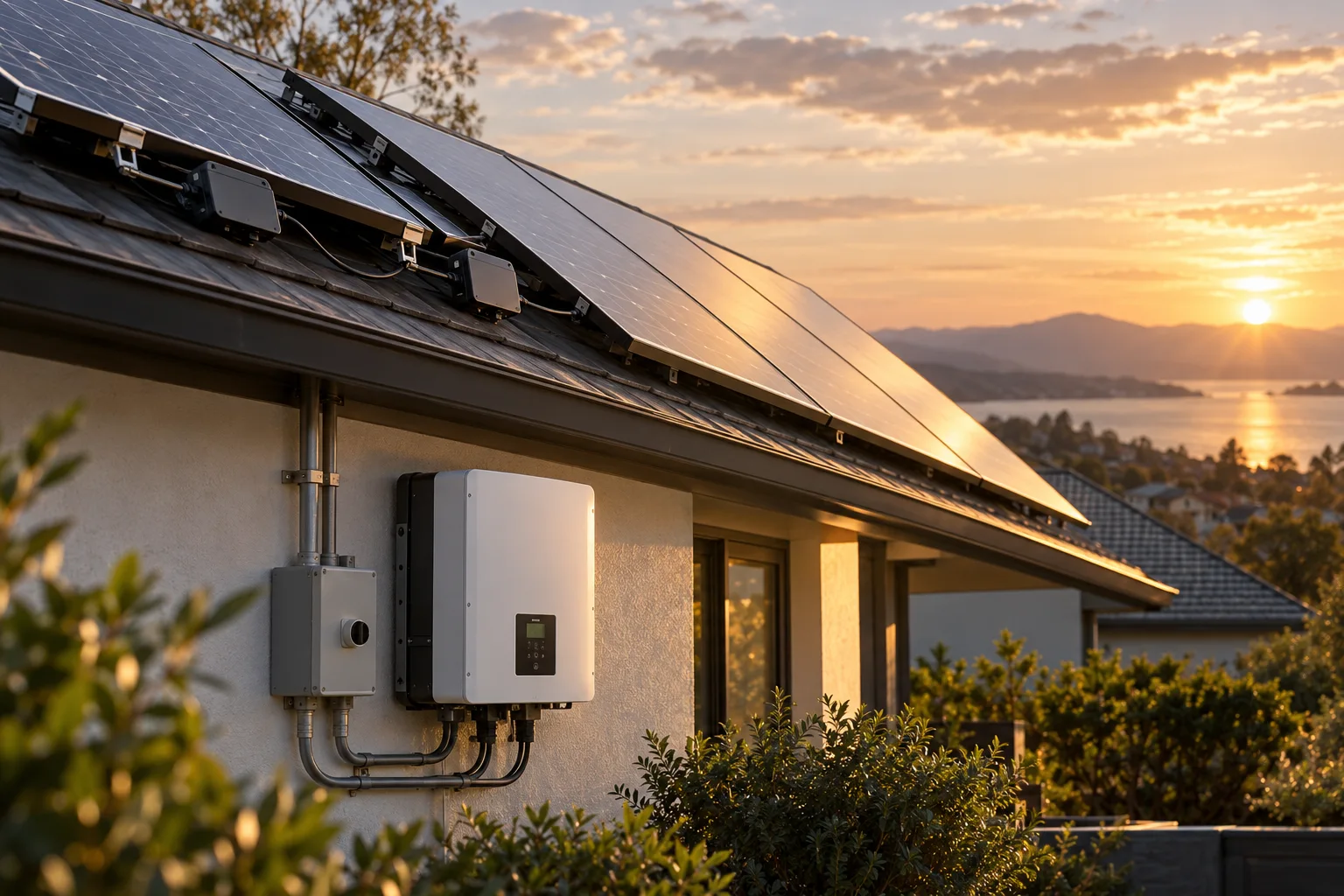
Solar farms and rooftop solar differ in scale, siting and grid connection, and which fits depends on local rooftops, land, grid capacity and policy.
Covers: Compares utility-scale solar farms with residential and commercial rooftop solar systems, covering scale, ownership, grid connection, land use, cost structures, efficiency and environmental trade-offs. It does not give installation quotes or cover off-grid or portable solar products.
Also answers: Solar farm vs rooftop solar · Difference between rooftop solar and solar farm · Utility-scale solar vs residential solar · What is a solar farm compared to rooftop panels?
The short answer
Interpretation AI-prepared starting mapA solar farm (utility-scale, centralized PV) and a rooftop system (decentralized PV on homes and commercial buildings) differ mainly in scale, where the power is generated and how it connects to the grid. Solar farms concentrate many panels on open land and feed into medium- and high-voltage networks, gaining economies of scale that lower installation… 12
In brief
Solar farms concentrate capacity on open land and connect to higher-voltage grids, gaining economies of scale and lower LCOE; rooftop systems spread capacity across buildings at low voltage.1
Evidence-backedUS rooftop technical potential is large: about 1,118 GW and 1,432 TWh/year, roughly 39% of national electric-sector sales.2
Evidence-backedFarms need significant land but have small lifecycle emissions relative to the fossil-fuel reductions they enable.1
Evidence-backedVery large rooftop deployment can warm urban surfaces and raise boundary-layer height, while lowering ground-level pollution.3
Evidence-backed
At a glance
The picture in numbers
Live · updated just now
65%
small buildings as a share of all building sizes (total)
- small buildings
- 731 GW
- all building sizes (total)
- 1,118 GW
39%
39 in every 100
26%
26 in every 100
24.4 km²
The evidence behind it
6 sources- Other studies and data5
- Background1
When it was published
Newest from 2026
| Source | Kind | Year |
|---|---|---|
| Technical, environmental and economic comparison of residential and utility-scale solar power generation systems | Background | 2026 |
| Centralized versus Decentralized Solar Grids for San Francisco | Other studies and data | 2025 |
| Rooftop Solar Photovoltaic Technical Potential in the United States. A Detailed Assessment | Other studies and data | 2016 |
| That’s Not Fair: Tariff Structures for Electric Utilities with Rooftop Solar | Other studies and data | 2021 |
| Rooftop photovoltaic solar panels warm up and cool down cities | Other studies and data | 2024 |
| Readiness for a clean energy future: Prevalence, perceptions, and barriers to adoption of electric stoves and solar panels in New York City. | Other studies and data | 2024 |
The community around it
No one has added to this page yet. Firsthand experience, a newer study or a different reading of the numbers would show up here, credited to you.
Shares and multiples are worked out from the figures the page states.
The full explanation
Interpretation AI-prepared starting mapA solar farm (utility-scale, centralized PV) and a rooftop system (decentralized PV on homes and commercial buildings) differ mainly in scale, where the power is generated and how it connects to the grid. Solar farms concentrate many panels on open land and feed into medium- and high-voltage networks, gaining economies of scale that lower installation costs and the levelized cost of electricity (LCOE). Rooftop systems spread capacity across many buildings and connect at low voltage. One assessment found US rooftop technical potential of about 1,118 GW of capacity and 1,432 TWh/year, roughly 39% of national electric-sector sales, with small buildings contributing about 65% of that potential. Which model suits a given place depends on rooftop availability, grid capacity, land, and local policy.12
- Evidence 16
- Interpretation 5
What it means for you
Which fits you?
Pick the situation closest to yours. Each answer says what it rests on.
If you are planning at city or system level and rooftop space is limited
utility-scale farms are likely more viable on cost and grid integration, while rooftop can complement them in a diversified low-carbon system.1
Evidence-backedIf you are in a dense city with abundant rooftops and little open land
a decentralized rooftop approach may be argued as more effective on efficiency, resource use, and cost, as in the San Francisco analysis.4
Evidence-backedIf you are assessing rooftop potential for a region
check both building suitability and total rooftop area, since suitability rates can be well below the share of buildings that have any suitable location.2
Evidence-backedIf you are a regulator setting tariffs for rooftop solar customers
design tariffs that distinguish usage tiers and solar versus non-solar customers, for example a buy-all, sell-all structure, to protect all stakeholders.5
Evidence-backedIf you are planning very large rooftop deployment in a hot city
account for urban warming and boundary-layer effects alongside the pollution reductions reported.3
Evidence-backedThe full story · 3 chapters
How it fits together
Chapter 1: Scale and grid connection
AI summary:Farms gain economies of scale on higher-voltage grids, while rooftop potential is large but spread across buildings at low voltage.
Evidence-backed: Utility-scale systems integrate more efficiently into existing medium- and high-voltage networks and benefit from economies of scale, resulting in lower installation costs and a lower LCOE. In a Geneva case study, meeting the city's annual demand with PV would require about 24.4 km² of installations; a fully residential deployment was judged spatially infeasible given limited rooftop availability and would need substantial upgrades to low-voltage grid infrastructure.1
Evidence-backed: Rooftop potential is large in aggregate. Across 128 US cities with lidar data, 83% of small buildings had a location suitable for PV, though only 26% of small-building rooftop area was suitable. Small-building rooftops could host 731 GW of capacity and generate 926 TWh/year, about 65% of total rooftop technical potential; all building sizes together reach an estimated 1,118 GW and 1,432 TWh/year, equal to 39% of national electric-sector sales.2
Evidence-backed: A student-journal analysis argues that for San Francisco a decentralized solar grid would be more effective than a centralized one because it uses electricity efficiently, takes up fewer natural resources, and is more favorable on cost, in a dense urban setting aiming for 100% renewable energy by 2045.4
Interpretation: These two positions point in different directions: system-level studies favor centralized farms for cost and grid fit, while a city-specific argument favors rooftop for dense urban areas. The difference appears to hinge on local rooftop availability, land, and grid capacity rather than a universal winner.14
This part rests on
2. Rooftop Solar Photovoltaic Technical Potential in the United States. A Detailed Assessment
We simulate the productivity of PV installed on the suitable roof area, and present the technical potential of PV on both small buildings and medium/large buildings for every state in the continental US. Within the 128 cities covered by lidar data, 83% of small buildings have a location suitable for a PV installation, but only 26% of the total rooftop area of small buildings is suitable for development. The sheer number of buildings in this class, however, gives small buildings the greatest technical potential. Small building rooftops could accommodate 731 GW of PV capacity and generate 926 TWh/year of PV energy, approximately 65% of rooftop PV's total technical potential. We conclude by summing the PV-generation results for all building sizes and therefore answering our original question, estimating that the total national technical potential of rooftop PV is 1,118 GW of installed capacity and 1,432 TWh of annual energy generation. This equates to 39% of total national electric-sector sales.Read original source
4. Centralized versus Decentralized Solar Grids for San Francisco
Climate change requires a transition to renewable energy sources, but different cities have different contextual needs that require place-specific solutions. Renewable energy sources like solar power reduce greenhouse gas emissions and are becoming more efficient. This makes solar energy an up-and-coming source of power for the city. By 2045, San Francisco wants to have 100% renewable energy. Given their urban environment, they must account for the city’s population energy density relating to energy consumption, trying to discuss whether solar energy can be seen as a viable source for this. Two possible ways to harness solar energy would be a centralized solar grid and a decentralized solar grid. A decentralized solar generation system would be more effective in San Francisco because it is efficient in electricity use, it takes up less natural resources, and it is economically more favorable cost-wise. Incorporating this form of solar energy in San Francisco will be beneficial for addressing climate change and supporting energy demand in the city and wider region.Read original source
1. Technical, environmental and economic comparison of residential and utility-scale solar power generation systems
Lifecycle greenhouse gas emissions are evaluated by comparing the current energy mix with a solar-only scenario, including manufacturing, infrastructure, and land-use impacts. Economic feasibility is assessed using installation and financing costs, storage requirements, land prices, and the levelized cost of electricity (LCOE). The results show that approximately 24.4 km² of PV installations would be required to meet Geneva’s annual demand. A fully residential deployment is spatially infeasible due to limited rooftop availability and would require substantial upgrades to low-voltage grid infrastructure. Utility-scale systems integrate more efficiently into existing medium- and high-voltage networks and benefit from economies of scale, resulting in lower installation costs and a lower LCOE. Although centralized solar farms require significant land area, their lifecycle emissions are small relative to the overall emission reductions achieved when fossil fuels are replaced. Overall, under full-solar assumptions, utility-scale PV systems are more viable at the system level, while residential PV can complement centralized generation within a diversified low-carbon energy system.Read original source
3 independent sources
Drawn from this chapter's text
Chapter 2: Land use and environmental effects
AI summary:Farms use significant land with small lifecycle emissions, while very large rooftop deployment can warm urban surfaces and lower ground-level pollution.
Evidence-backed: Centralized solar farms require significant land area, but their lifecycle emissions are small relative to the overall emission reductions achieved when fossil fuels are replaced. The Geneva study evaluated lifecycle greenhouse gas emissions including manufacturing, infrastructure, and land-use impacts.1
Evidence-backed: Large-scale rooftop PV has its own urban climate effects: in the most aggressive deployment scenario it warmed the urban surface by increasing sensible heat flow and turbulence, raising planetary boundary layer height by up to 535.6 m, which in turn lowered ground-level pollution concentrations. This study examined rooftop deployment, not solar farms.3
Interpretation: Rooftop systems reuse existing building surfaces, so they avoid the land footprint of farms, while farms trade land for scale and grid efficiency. The urban-climate findings suggest rooftop deployment is not environmentally neutral at very large scale, though the pollution effect reported was downward.23
Chapter 3: Cost structures and fairness
AI summary:Scale gives farms lower costs, but rooftop raises tariff-design questions about usage tiers and crediting that shift the comparison.
Evidence-backed: Economies of scale give utility-scale systems lower installation costs and a lower LCOE than residential systems in the Geneva comparison, which also weighed storage requirements, land prices, and financing.1
Evidence-backed: Rooftop solar raises tariff-design questions. An analysis using Nevada and New Mexico data argues an effective electricity tariff must distinguish among customer usage tiers and between customers with and without rooftop solar to reach socially desirable outcomes, and can be implemented as a simple buy-all, sell-all tariff. Many US utilities operate tariffs missing at least one of these features, and regulators would need to overhaul them to safeguard all stakeholders.5
Add a source or a different interpretation
What would strengthen or challenge this answer?
Your contribution joins the discussion. Changes to the shared answer are reviewed separately.
Your turn
Where do you stand?
The conversation starts here
A few questions from this page to take the topic further. Bring a source, another angle or something you've tried.
3 open questions
- ResearcherLooks for evidenceFrom this page
The page notes the scale comparison rests largely on a Geneva case study and a US rooftop-potential assessment. What additional evidence would let you compare solar farm and rooftop costs across more regions?
- ChallengerTests an assumptionFrom this page
The page says which model fits depends on rooftop availability, land, grid capacity and tariff design. In what local conditions might a solar farm be the weaker choice rather than rooftop solar?
- ExplorerInvites experienceFrom this page
The page mentions very large rooftop deployment can warm urban surfaces and raise boundary-layer height. What would you want to know before judging whether that effect matters in a given city?
Test what you remember
Fill in the blank: small buildings: ?% of all building sizes (total)
Drag the slider to fill in the blank
Did this answer your question?
Be the first to voteMore quick questions: how you feel, and questions from connected pages
How do you feel about this?
No votes yetQuick questions from connected pages
Keep exploring
Where this leads
What is the difference between a solar farm and a rooftop solar system?You are here
A different angle
One finding can inform several topics. Connections and subtopic reports are shown for exploring; they aren't extra evidence for this page.
Before you go
What to remember
Try to recall each hidden figure before you reveal it. Remembering, not rereading, is what makes it stick.
US rooftop technical potential is large: about GW and 1,432 TWh/year, roughly 39% of national electric-sector sales.
Solar farms concentrate capacity on open land and connect to higher-voltage grids, gaining economies of scale and lower LCOE; rooftop systems spread capacity across buildings at low voltage.
Farms need significant land but have small lifecycle emissions relative to the fossil-fuel reductions they enable.
Your reading
0 of 3 chaptersThis answer keeps changing
When new evidence or a better source comes in, this page is updated (it's on version 2, last changed 1 hour ago). Follow it to be told when that happens.
 Up nextWhat is the difference between a solar panel and a solar thermal system?
Ask this Sylo
Still wondering about something?
Answers come only from this page's reviewed material, with citations, and say plainly when the page doesn't cover it yet.
Follow the story
This page changes as sources and experiences are reviewed. Follow it, share it or add what you know.
Behind this page
Who's adding to it, where it comes from, how it changed and what would make it better. Always open to everyone.
Discussion
Sources
Numbers match the citations in the article. A working link isn't proof that a page supports a claim; check the quoted passage and date.
- 1Technical, environmental and economic comparison of residential and utility-scale solar power generation systemsLUTPub (LUT University) (Forgó)Published Jan 1, 2026Checked Oct 18, 2026
“Lifecycle greenhouse gas emissions are evaluated by comparing the current energy mix with a solar-only scenario, including manufacturing, infrastructure, and land-use impacts. Economic feasibility is assessed using installation and financing costs, storage requirements, land prices, and the levelized cost of electricity (LCOE). The results show that approximately 24.4 km² of PV installations would be required to meet Geneva’s annual demand. A fully residential deployment is spatially infeasible due to limited rooftop availability and would require substantial upgrades to low-voltage grid infrastructure. Utility-scale systems integrate more efficiently into existing medium- and high-voltage networks and benefit from economies of scale, resulting in lower installation costs and a lower LCOE. Although centralized solar farms require significant land area, their lifecycle emissions are small relative to the overall emission reductions achieved when fossil fuels are replaced. Overall, under full-solar assumptions, utility-scale PV systems are more viable at the system level, while residential PV can complement centralized generation within a diversified low-carbon energy system.”
- 2Rooftop Solar Photovoltaic Technical Potential in the United States. A Detailed AssessmentResearch paper (Gagnon et al.)Published Jan 1, 2016Checked Oct 18, 2026
“We simulate the productivity of PV installed on the suitable roof area, and present the technical potential of PV on both small buildings and medium/large buildings for every state in the continental US. Within the 128 cities covered by lidar data, 83% of small buildings have a location suitable for a PV installation, but only 26% of the total rooftop area of small buildings is suitable for development. The sheer number of buildings in this class, however, gives small buildings the greatest technical potential. Small building rooftops could accommodate 731 GW of PV capacity and generate 926 TWh/year of PV energy, approximately 65% of rooftop PV's total technical potential. We conclude by summing the PV-generation results for all building sizes and therefore answering our original question, estimating that the total national technical potential of rooftop PV is 1,118 GW of installed capacity and 1,432 TWh of annual energy generation. This equates to 39% of total national electric-sector sales.”
- 3Rooftop photovoltaic solar panels warm up and cool down citiesNature Cities (Khan et al.)Published Oct 7, 2024Checked Oct 18, 2026
“Another interesting finding is that the onset of sea breeze circulation occurs earlier in the afternoon due to regional low-pressure effects within a deeper planetary boundary layer (PBL) height and offshore synoptic winds above the atmospheric boundary layer. Finally, large-scale RPVSPs significantly warm the urban surface by increasing sensible heat flow and concomitant turbulence in the lower atmosphere, resulting in an increase in PBL height by up to 535.6 m in the most aggressive scenario (RPVSPs100%). This leads to lower pollution concentrations at ground level. The stronger vertical wind caused by large-scale RPVSPs indicates a stronger influence of convective rolls on the urban atmosphere during heatwave events. Additionally, we fully evaluated 30 case studies from local, national, and global scales to verify and compare the current study's findings. Overall, this study provides valuable insights for policymakers to plan and implement the deployment of large-scale RPVSPs in an informed manner.”
- 4Centralized versus Decentralized Solar Grids for San FranciscoJournal of Student Research (Sathish)Published Feb 28, 2025Checked Oct 18, 2026
“Climate change requires a transition to renewable energy sources, but different cities have different contextual needs that require place-specific solutions. Renewable energy sources like solar power reduce greenhouse gas emissions and are becoming more efficient. This makes solar energy an up-and-coming source of power for the city. By 2045, San Francisco wants to have 100% renewable energy. Given their urban environment, they must account for the city’s population energy density relating to energy consumption, trying to discuss whether solar energy can be seen as a viable source for this. Two possible ways to harness solar energy would be a centralized solar grid and a decentralized solar grid. A decentralized solar generation system would be more effective in San Francisco because it is efficient in electricity use, it takes up less natural resources, and it is economically more favorable cost-wise. Incorporating this form of solar energy in San Francisco will be beneficial for addressing climate change and supporting energy demand in the city and wider region.”
- 5That’s Not Fair: Tariff Structures for Electric Utilities with Rooftop SolarManufacturing & Service Operations Management (Singh & Scheller-Wolf)Published Jan 5, 2021Checked Oct 18, 2026
“We illustrate that the effectiveness of tariff structures is not governed simply by the number of free tariff parameters, but by the functions these parameters serve. In particular, an effective tariff must discriminate among customer usage tiers and between customers with and without rooftop solar to achieve socially desirable outcomes. We present a tariff structure with these two characteristics and show how it can be implemented as a simple buy-all, sell-all tariff while retaining its favorable properties. We illustrate our findings numerically using data from Nevada and New Mexico, two states grappling with this issue. Managerial implications: Many utilities in the United States operate tariff structures that are missing at least one of the two identified features. Regulators must overhaul these tariff structures to adequately safeguard all stakeholders.”
- 6Readiness for a clean energy future: Prevalence, perceptions, and barriers to adoption of electric stoves and solar panels in New York City.Energy policy (Lane et al.)Published Sep 5, 2024Checked Oct 18, 2026
“This study assessed prevalence and perceptions of these clean-energy technologies to increase adoption in New York City (NYC). A representative survey of 1,950 NYC adults was conducted from February 28 to April 1, 2022. Fourteen percent of people had an electric stove; 86% had gas stoves. Black, Latino/a, and lower-income residents were more likely to have electric stoves than White and higher-income residents. Only 14% of residents were interested in switching from gas to electric stoves. Of the 71% with gas stoves uninterested in switching, nearly half (45%) preferred gas cooking, particularly among White and higher-income residents, indicating a large opportunity to shift preferences. About 5% used solar for their home or building; another 77% were interested in solar. Of the 18% uninterested in solar, reasons included lack of agency, confusion about operation, and costs. Education about health and cost benefits, induction technology, how to transition, available subsidies, and other efforts to reduce adoption barriers can support clean technology uptake. Residential clean energy metrics should be tracked regularly to ensure that technology adoption proceeds equitably.”
How it changed
Published 1 time since Oct 18, 2026.
- Version 2Oct 18, 2026Live now
AI-prepared Starting Map from live research.
- First published version.
Help improve it
The brief is open about what's uncertain. These are the specific gaps that new material would fill.
Open questions
What mix of rooftop and utility-scale solar is optimal for a given city, given its rooftop availability, land, and grid capacity?
No answers yet
How large must rooftop deployment be before the urban warming and pollution effects become significant, and how do they compare with a solar farm on the same energy output?
No answers yet
Which tariff designs fairly share the costs of rooftop solar between owners and other customers?
No answers yet
Explore how this topic connects
Narrower questions connect to broader Sylos. Explore their findings, sources and the people contributing to each.